What Is Inflation?
Inflation is the sustained increase in the general price level of goods and services over time. When inflation occurs, each unit of currency buys fewer goods and services than it did before—essentially, your money loses purchasing power.
As of early 2026, U.S. inflation (measured by CPI) sits around 2.4% annually—moderate compared to recent peaks, but still eroding value steadily. Central banks often target ~2%, but higher or unexpected inflation can accelerate the damage.
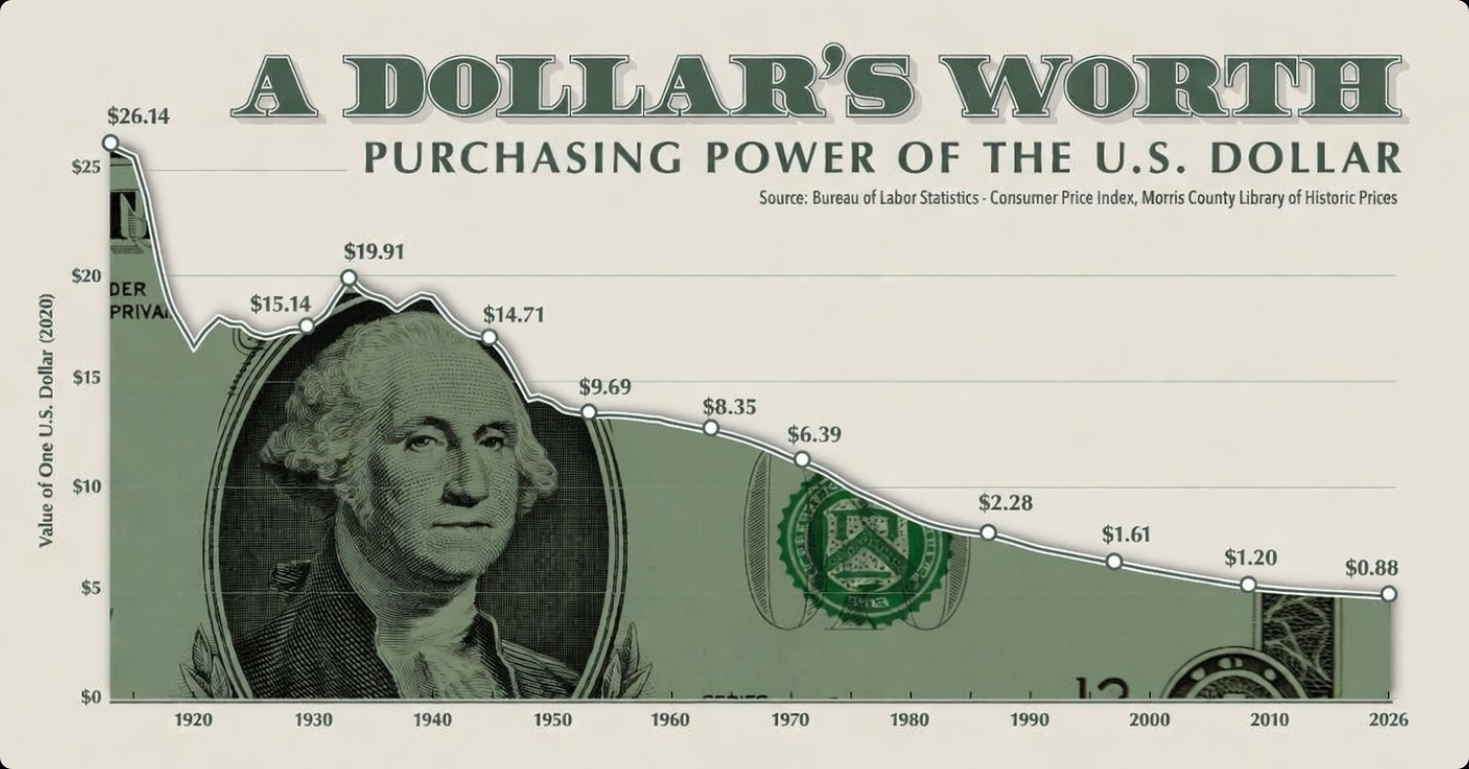
The chart below shows the steady decline in the purchasing power of the dollar from the early 1900s to today.
How Inflation Hurts the Average Person
Inflation acts like a hidden tax, quietly reducing what your money can actually buy. It hits hardest when wages don't keep pace with rising costs. Low-income families often face the worst impact—they have less flexibility to switch brands, buy in bulk, or invest to outpace inflation.
- Erodes savings & cash holdings: Money in a bank account or under the mattress loses real value year after year.
- Raises everyday costs: Food, gas, rent, utilities, and groceries become more expensive—especially painful for low- and middle-income households who spend a larger share of income on necessities.
- Reduces standard of living: Even if your salary rises, if prices rise faster, you can afford less housing, travel, education, or retirement security.
- Hurts fixed-income groups most: Retirees, pensioners, and those on static incomes feel the squeeze quickly with no easy way to adjust.
- Creates uncertainty: People cut back on spending, delay big purchases, or switch to cheaper alternatives, which can slow economic growth and job opportunities.
Why Bitcoin Is a Superior Asset for Preserving Purchasing Power
Bitcoin was designed from the ground up to resist the very problems fiat currencies face: endless supply expansion and devaluation.
- Fixed supply cap: Only 21 million Bitcoins will ever exist—hardcoded into the protocol. No central authority can print more, unlike fiat money where governments and banks can increase the supply at will.
- Programmed scarcity via halvings: Every ~4 years, the rate of new Bitcoin creation halves (most recent in 2024), making it increasingly scarce over time—its annual "inflation" rate is now under 1% and falling.
- Decentralized & censorship-resistant: No single entity controls it, protecting against political or monetary policy decisions that fuel inflation.
- Digital gold qualities: Portable, divisible, verifiable, and borderless—ideal for preserving value in a digital, global world. Many view it as "digital gold" upgraded for the 21st century.
- Long-term track record: Despite short-term volatility, Bitcoin has historically outperformed inflation and many traditional assets during periods of monetary expansion and currency debasement.
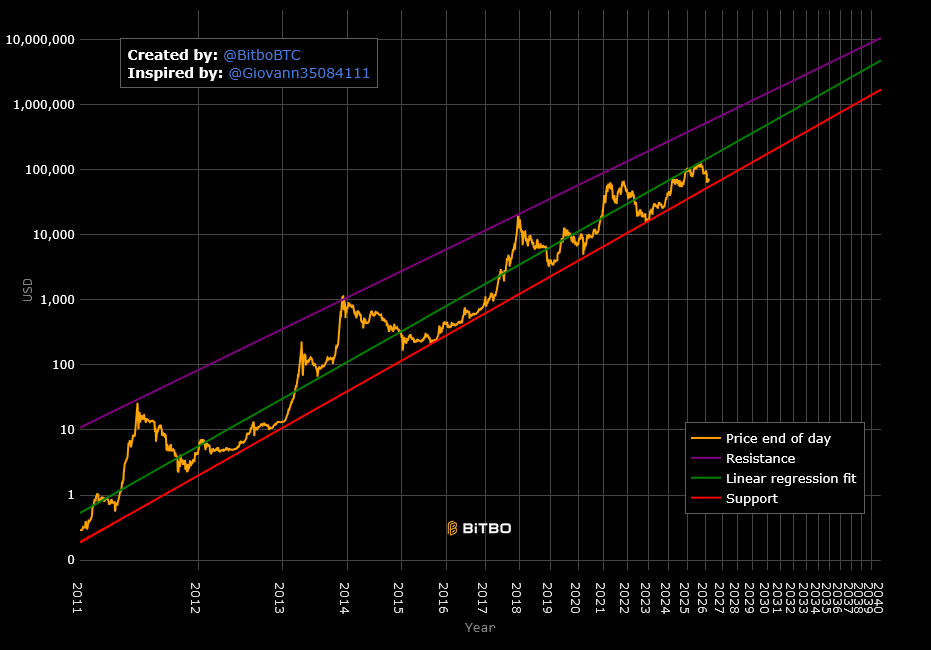
- Adoption / Growth: Bitcoin has outperformed most other assets since its inception. The long term power law model shown below has gained popularity in the Bitcoin community. Popularized by physicist Giovanni Santostasi it shows that Bitcoin's price follows a predictable long-term mathematical pattern over time, resembling natural scaling laws seen in cities, biology, or physics rather than behaving like a typical financial asset.
While no asset is risk-free (Bitcoin is volatile and not a guaranteed short-term hedge), its structural design makes it uniquely positioned to protect purchasing power against the ongoing erosion caused by inflationary fiat systems.